

August 28, 2026
Insights
Weekly News l Loyalty Moves Closer to the Transaction
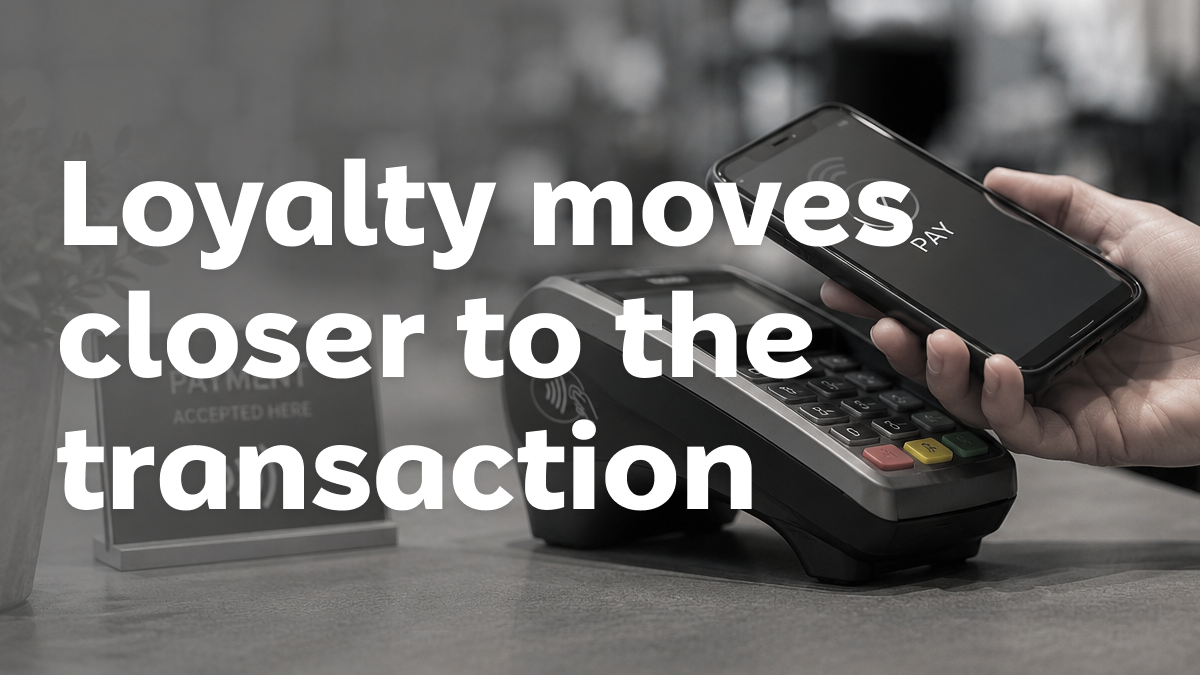
This week’s TLP Signals explores the growing convergence of loyalty, payments and customer experience. From AI-powered commerce infrastructure and digital wallets to CRM consolidation and rewards ecosystems, the latest moves reveal a bigger shift: the companies that own the transaction, the data and the customer workflow are increasingly shaping who owns the customer relationship.
- Anouncement
- |
- Anouncement
- |
- Anouncement
This week’s signals point to a continued collapse of the boundaries between loyalty, payments and customer engagement.
The interesting developments are not really about adding another reward, another payment method or another AI feature. They are about where customer relationships are being owned. Payments companies are moving into engagement. Rewards platforms are expanding into broader spending ecosystems. CRM vendors are consolidating the infrastructure beneath customer operations.
The strategic question underneath all of it is becoming harder to ignore: if you own the transaction, the data and the customer interaction layer, how much of the relationship can you control?
🇺🇸 Stripe doubles down on AI infrastructure — and walks away from PayPal
This week brought two very different signals from Stripe. Reuters reported that the company and Advent had abandoned their pursuit of PayPal, ending what could have become one of the largest fintech acquisitions in history. At the same time, Stripe has been pushing deeper into AI infrastructure through its reported acquisition of OpenRouter.
Those developments matter together. Buying PayPal would have been a huge bet on scale in an established consumer payments ecosystem. Building further into AI infrastructure points somewhere different: towards becoming part of the commercial infrastructure powering a new generation of digital transactions.
That distinction is important for the loyalty and payments market. The next battle may not simply be about owning the checkout. It may be about owning the infrastructure through which AI systems discover, select and ultimately pay for products and services.
Why this matters
As commerce becomes more agent-mediated, the companies sitting closest to payment execution could gain influence over customer journeys long before a traditional loyalty or CRM system gets involved.
🇺🇸 PayPal and Venmo move into another everyday spending category: tuition
PayPal and Venmo announced new integrations with Illumia, Nelnet Campus Commerce and TouchNet, allowing students and families to use the services for tuition payments.
On the surface, this is another payment-method expansion. Strategically, it is more interesting than that. Tuition is a large, emotionally significant and relatively infrequent expense — exactly the kind of transaction category that has traditionally sat outside the everyday digital wallet experience.
Payments platforms are steadily looking for more moments in which they can become the customer's default interface for money. The more categories they absorb, the more behavioural and transaction data they accumulate around the broader customer relationship.
Why this matters
Customer engagement increasingly follows spending behaviour rather than traditional sector boundaries. A wallet that starts with peer-to-peer payments can become relevant to education, retail, subscriptions and other major financial moments.
🇺🇸 Salesforce and Anthropic push AI further into the commercial stack
Salesforce expanded its partnership with Anthropic alongside its latest results, introducing “Claudeforce” as part of a broader effort to bring Anthropic’s models into sales, service and marketing workflows.
The commercially relevant point is not simply that another software company has announced an AI partnership. Salesforce is trying to make advanced AI part of the existing operating layer where customer data, commercial processes and employee workflows already sit.
That is a much more consequential proposition than adding a standalone chatbot. If AI agents are going to take on more customer-facing and revenue-generating work, the platforms with the deepest integration into customer records, permissions and workflows have a structural advantage.
Why this matters
The next phase of AI in CX is increasingly an infrastructure question. The winners will not necessarily be the companies with the most impressive model, but those that can connect intelligence safely to the systems where customer work actually happens.
🇺🇸 Vanguard buys its way closer to the adviser relationship
Vanguard announced a deal to acquire fintech platform Altruist, strengthening its technology capabilities for independent financial advisers.
This is a useful reminder that customer strategy is not limited to consumer-facing brands. In financial services, the adviser is often the critical relationship layer between the institution and the end customer.
By bringing more technology infrastructure into its orbit, Vanguard is positioning itself to participate more deeply in the workflows through which advisers manage relationships, recommendations and assets.
Why this matters
The most valuable customer relationship is often controlled by the party embedded in the workflow, rather than the party providing the underlying product. That principle applies just as much to CRM, loyalty and payments as it does to wealth management.
🇺🇸 Shopr Rewards connects everyday cashback with travel
Shopr Rewards has expanded its rewards ecosystem into travel, bringing shopping, cashback and travel savings together within a single platform.
The logic is familiar from some of the strongest loyalty ecosystems: engagement increases when the programme has more reasons to be useful. A reward earned during everyday spending can now contribute towards a higher-value future purchase.
What makes this commercially interesting is the attempt to connect high-frequency and lower-frequency spending. Retail and restaurant transactions create regular engagement opportunities; travel provides a more aspirational redemption or savings category.
Why this matters
The strongest loyalty propositions increasingly combine everyday utility with occasional high-value moments. The goal is not simply to reward more transactions, but to make the value exchange relevant across more of a customer's spending life.
🇺🇸 Crescendo makes a case for collapsing the CX stack
Crescendo launched its Customer Experience Platform this week, bringing AI agents, contact-centre capabilities, ticketing, workforce management, quality, voice of customer and knowledge into one platform.
Whether every enterprise wants a single provider for all of those functions is another question. But the strategic direction is clear: the fragmented CX stack itself is becoming a commercial problem.
For years, brands have assembled customer operations from specialist tools, each with its own data structures and workflows. The cost of that fragmentation becomes more visible when businesses try to deploy AI across the full service operation.
Why this matters
AI may accelerate CX platform consolidation because intelligence is only as useful as the data and workflows it can access. The next generation of customer infrastructure could be built around fewer, more deeply connected systems.
🇲🇾 StoreHub becomes a testing ground for payments and rewards innovation
ShardLab has taken a strategic stake in Southeast Asian commerce and payments platform StoreHub, with the two companies launching a joint venture to develop new payments and rewards products.
StoreHub already sits across point of sale, payments, loyalty and online ordering for more than 20,000 merchant locations. That gives the partnership something more valuable than an idea: an existing operating network in which propositions can be tested against real merchant and customer behaviour.
This is an increasingly important model for innovation. Rather than launching a new loyalty or payment product into the market and hoping distribution follows, companies are building on top of ecosystems that already have transactions, merchants and customer relationships.
Why this matters
Distribution is becoming one of the biggest advantages in customer innovation. Platforms with an installed transaction base can test and scale new propositions much faster than standalone products starting from zero.
🇺🇸 Bluefin and Visa tackle a less glamorous but critical part of CX: payment friction
Bluefin and Visa announced a joint card-present acceptance offering combining payment processing, tokenisation, security, device management and point-to-point encryption.
It is easy to separate payment infrastructure from customer experience because consumers rarely see the technology behind the transaction. But payment failure, friction and uncertainty are some of the fastest ways to damage a customer relationship.
The significance here is the continued move towards more unified commerce infrastructure. Merchants are being offered a single route into multiple layers of the transaction stack rather than managing separate relationships and integrations for each capability.
Why this matters
Not all CX innovation happens in visible customer interfaces. Some of the most valuable improvements come from removing operational friction underneath the transaction before the customer ever notices there was a problem.
🇬🇧 SPAR UK shows that gamification still works when it is tied to a real event
SPAR North of England reported 113,500 rewards redeemed through its “Win With Every Goal” campaign, with 55,000 players taking part.
The numbers are a useful counterpoint to the tendency to treat gamification as a novelty mechanic. In this case, the proposition was connected to an external cultural event and gave customers a reason to return and participate repeatedly.
That matters because loyalty engagement does not always require a permanent programme redesign. Well-timed campaign mechanics can create short-term frequency when they connect with something customers are already paying attention to.
Why this matters
The best gamification does not ask customers to care about the game itself. It attaches the reward mechanic to an existing behaviour, cultural moment or habit that already has attention.
🇺🇸 Veeva wins two major global CRM commitments
Veeva announced that both Biogen and Regeneron have committed globally to Veeva Vault CRM, with the platform positioned as a more connected, AI-enabled commercial foundation for life sciences.
The sector is specialised, but the strategic signal is broader. CRM platforms are being judged less as databases for recording customer activity and more as the operating environment through which organisations gather evidence, coordinate decisions and run commercial engagement.
The shift towards “agentic” CRM language can sound fashionable. The more meaningful question is whether AI can improve the quality of the information feeding commercial decisions, rather than simply generating more automated activity.
Why this matters
CRM is evolving from a system of record towards a system of commercial intelligence. The opportunity is not automation for its own sake, but reducing the distance between customer interaction, organisational learning and action.
The conversation doesn't stop here.
Join the people bulding & debating this - in real time.

TLP is a collective-led platform for people working in customer loyalty, CX, CRM and marketing.