

September 25, 2026
Insights
Loyalty Is Moving Into the Transaction
This week in TLP Signals, loyalty moves closer to the transaction. From Majestic connecting loyalty across its shopping ecosystem to Revolut experimenting with biometric payments and AI agents beginning to reshape how customers buy, the boundaries between loyalty, payments, CRM and commerce are becoming increasingly blurred. We look at the customer infrastructure behind these moves — and what it means for brands trying to build stronger, more valuable relationships.
- Anouncement
- |
- Anouncement
- |
- Anouncement
The interesting customer stories this week are less about loyalty programmes in isolation and more about what happens when loyalty, payments, commerce and customer data start collapsing into the same infrastructure.
From Majestic putting loyalty across its entire purchasing ecosystem to Revolut testing facial-recognition payments in London, the direction of travel is clear: the customer relationship is increasingly being built into the transaction itself. Meanwhile, travel, hospitality and fintech are pushing further into embedded payments and interconnected ecosystems.
There is also a more important question emerging underneath the agentic commerce headlines: if AI starts making purchases for customers, who actually owns the relationship? The payment layer, the merchant, the loyalty programme — or the agent in between?
This week's signals are about those shifts.
🇬🇧 Majestic puts loyalty at the centre of its entire shopping journey
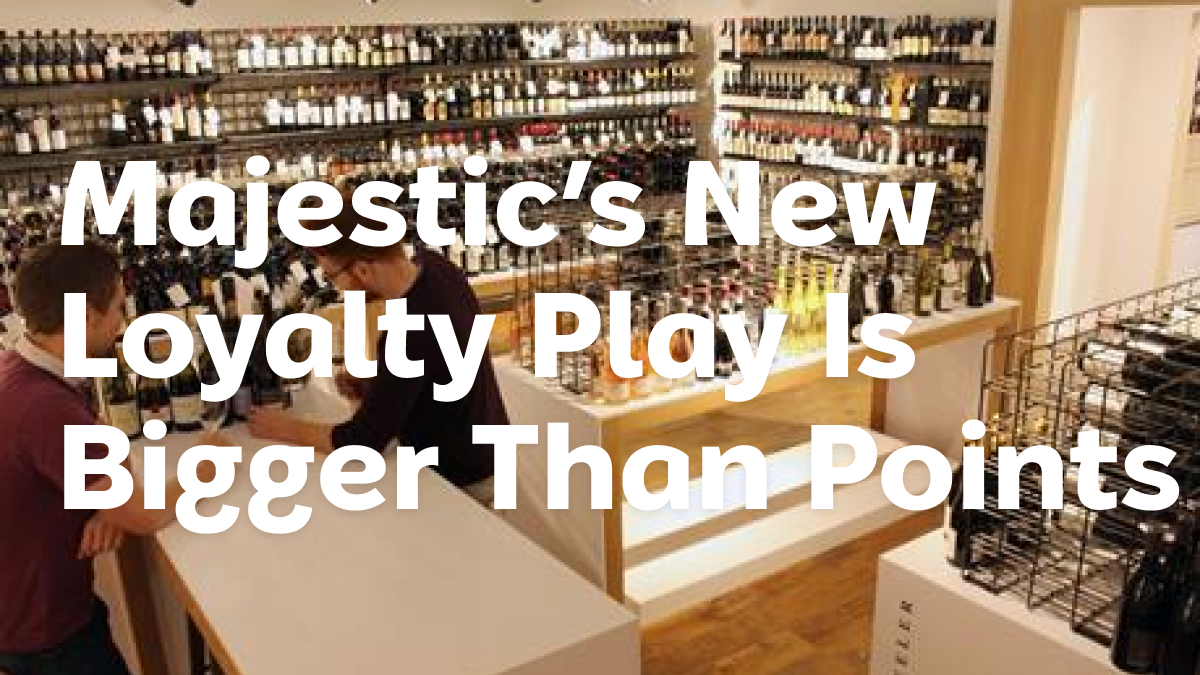
Majestic has launched its first digital loyalty programme alongside a new smartphone app, bringing together purchases across stores, online, the app, Wine Club and its Lock It In subscription service. Customers earn one point for every £1 spent, with rewards unlocked at different thresholds.
What makes this more interesting than another points launch is the infrastructure around it. The app combines loyalty with wishlists, tasting notes, ratings, stock visibility and Shop Local, giving customers reasons to return even when they are not immediately buying.
Majestic says Shop Local already accounts for more than half of orders placed through its website. That makes the app less of a loyalty wrapper and more of a digital layer connecting discovery, local inventory, fulfilment and rewards.
Why this matters
The strongest loyalty programmes increasingly sit across the customer journey rather than at the end of it. The opportunity is not simply to reward spend, but to make the ecosystem itself more useful.
🇬🇧 Revolut turns payment into a loyalty moment
Revolut has begun piloting facial-recognition payments in three London Kiss the Hippo cafés, allowing opted-in customers to pay without a phone, wallet or physical card. The pilot runs from 24–26 September and uses Revolut Register, with merchants offered 0% processing fees for the new payment method.
There is a loyalty layer built directly into the experiment too: customers using Pay with Smile earn triple RevPoints on every transaction. In other words, the payment credential, payment experience and loyalty mechanic are being designed as one proposition rather than separate pieces of the customer journey.
That is strategically more interesting than the facial-recognition gimmick itself. Revolut is trying to own the merchant infrastructure, the payment relationship and the rewards relationship simultaneously.
Why this matters
Payment is one of the most valuable moments in the customer relationship because it is where intent becomes behaviour. Whoever controls that moment has an unusually powerful position to influence frequency, rewards and retention.
🇺🇸 At Home rebuilds loyalty around customer input
US home retailer At Home has launched Design Rewards, replacing its Insider Perks programme after using customer research, focus groups and behavioural testing to shape the proposition. One outcome of that research was a $10 coupon for every 1,000 points earned.
The notable point is not the mechanics of the programme. It is the development process. At Home says customer input directly influenced the design of the proposition rather than treating loyalty as something created internally and pushed outward.
That is an important distinction as loyalty programmes become more expensive to operate and customers become more selective about which ones are actually worth engaging with.
Why this matters
Customer-led programme design is becoming a commercial discipline in its own right. The question is shifting from “What benefits can we give members?” to “What behaviour and value exchange have customers actually told us they want?”
🇺🇸 Arby’s goes back to basics — but makes the economics clearer
Arby’s has launched Loaded Rewards, a new loyalty programme built around points on every purchase, additional points for larger orders and rewards linked to spend. New members receive a free sandwich after a $5 first order and double points on their second order. Existing members were automatically migrated into the new programme in August.
There is nothing particularly futuristic about the mechanics, and that is precisely why it is worth watching. The programme is explicitly designed around encouraging another visit quickly rather than simply accumulating an abstract points balance.
The interesting loyalty question is therefore not always about complexity. Sometimes the commercial job is much simpler: acquire a customer, give them a reason to come back, then create a habit.
Why this matters
Loyalty still has to perform a basic economic function. Sophisticated technology is useful only if it ultimately changes frequency, basket size, retention or customer value.
🇻🇳 Visa and Sun Group connect tourism, payments and loyalty
Visa and Vietnamese tourism group Sun Group have established a strategic partnership covering digital tourism, customer experience, loyalty, technology and data, payments and international marketing. The partnership is particularly focused on Phu Quoc and preparations around the APEC 2027 Economic Leaders’ Meeting.
The partnership also explores Sun Group participating in Visa Destinations, potentially allowing its accommodation, dining and entertainment businesses to be promoted to Visa cardholders before they travel.
This is a useful example of where loyalty is heading in travel: away from a single hotel or airline programme and towards an ecosystem connecting destination discovery, payment credentials, experiences and customer data.
Why this matters
Travel customers do not experience destinations in organisational silos. The more effectively payments, hospitality, attractions and loyalty connect, the more opportunity there is to influence the entire customer journey rather than one booking.
🇬🇧 GoCardless puts the payment inside the conversation
GoCardless has processed what it describes as the UK's first agentic account-to-account payment, with an AI-driven donation to Trussell completed through a conversational interface. The customer selected a donation amount in the AI interaction before entering bank details to establish a Direct Debit mandate.
The important detail is that the payment does not simply happen after the AI conversation. The transaction itself becomes part of the conversation.
That raises a much bigger CRM question. If the interface that understands the customer's intent is also capable of completing the transaction, traditional distinctions between marketing, commerce and payments start to become much less meaningful.
Why this matters
The next customer journey may not be “advert → website → checkout”. It may be conversation → decision → payment, all in one environment. Brands will need to understand where their customer relationship sits when the interface is controlled by an agent.
🇨🇦 Mastercard tests the rules for consumer-controlled agentic commerce
Mastercard, Flybits and Rogers Bank have announced a Canadian agentic-commerce transaction designed around consumer control, transparency and security. The companies are using Mastercard Agent Pay to test how AI-powered shopping can connect consumers, issuers and payment networks while retaining defined safeguards.
The commercial significance is less about one transaction than the infrastructure being built around it. As AI systems become capable of shopping on behalf of customers, payments networks and financial institutions need a way to authenticate that the agent is acting within the customer's permissions.
That creates an emerging layer between the customer and the merchant: the authorised agent.
Why this matters
Loyalty has historically depended on knowing who the customer is and what they value. Agentic commerce introduces another question: who is actually making the decision? The answer could fundamentally change how brands acquire, recognise and retain customers.
🌍 Banks start pushing back on the agentic-commerce rush
Major banks including NatWest, Bank of America, ING, Capital One and Commonwealth Bank of Australia have raised concerns about AI shopping agents, particularly around fraud, data privacy, consumer protection and the possibility of agents steering transactions towards less secure payment methods.
The concern is commercially important because agentic commerce is developing faster than the surrounding customer-protection framework. Reuters also reports that John Lewis has seen AI-originated searches rise from 0.3% to 2.5% of searches in a year — a small absolute number, but a significant directional change.
For brands, the challenge is not simply figuring out how to become visible to AI agents. It is understanding what happens to trust when an intermediary begins selecting products and payment options on the customer's behalf.
Why this matters
Customer experience has always involved a question of trust. Agentic commerce adds a new participant to that relationship. The brands that succeed will need to earn trust not only from people, but from the systems increasingly acting on their behalf.
🇺🇸🇳🇱 Perk and Katanox push payments deeper into business travel
Travel and spend platform Perk has partnered with hospitality infrastructure company Katanox to improve how hotel stays are booked, paid, reconciled and settled. The partnership also expands access to hotel inventory and loyalty content while embedding hotel payments into the booking flow.
This is an example of customer experience infrastructure that most travellers will never see. Removing payment friction, reducing reconciliation work and improving hotel connectivity can make the experience materially better without adding another customer-facing feature.
It also demonstrates why payments infrastructure is becoming strategically important beyond checkout. In travel, payment affects booking, settlement, expense management, loyalty and operational efficiency simultaneously.
Why this matters
The best customer experience improvements are not always visible. Sometimes the biggest gains come from removing the infrastructure problems that create friction behind the scenes.
🇬🇧🇦🇪 PhonePe takes its payments ecosystem into the UAE
India's PhonePe has received in-principle approval from the UAE central bank for licences covering retail payment services, card schemes and stored-value facilities. The company still requires final regulatory approval before commercial operations can begin.
PhonePe's significance is its ecosystem model. Built around India's UPI infrastructure, the company has developed beyond simple payments into a broader consumer financial platform.
The UAE move therefore represents more than geographic expansion. It shows how payment platforms can use an existing customer relationship and transaction infrastructure as the foundation for entering adjacent financial services and markets.
Why this matters
Payments are increasingly becoming platforms rather than utilities. Once a company owns enough of the transaction relationship, the commercial opportunity extends into financial products, rewards, commerce and customer data.
The signal underneath the signals
The strongest developments this week share a common thread: the customer relationship is moving closer to infrastructure.
Loyalty is being embedded into apps and payment credentials. Payments are becoming part of conversational and AI-led commerce. Travel companies are connecting loyalty with booking and settlement infrastructure. Retailers are using customer insight to redesign the economics of their programmes.
The old model was largely sequential: acquire the customer, sell something, transact, then use CRM and loyalty to bring them back.
The emerging model is much more interconnected. Identity, payment, data, loyalty and commerce are increasingly becoming one system.
That is where the most interesting customer strategy work is happening now.
The conversation doesn't stop here.
Join the people bulding & debating this - in real time.

TLP is a collective-led platform for people working in customer loyalty, CX, CRM and marketing.