

October 2, 2026
Insights
The customer relationship is becoming infrastructure
This week on TLP Signals, we look at how the customer relationship is becoming infrastructure. From Sainsbury’s taking Nectar into financial services and Qantas embedding loyalty into holiday booking, to Mastercard building trust layers for agentic payments and Salesforce bringing customer research closer to CRM, the boundaries between loyalty, payments, CX and commerce are getting harder to separate. Across retail, travel, fintech and customer technology, the common thread is clear: the most interesting moves are happening where customer data, transactions and engagement meet. We unpack the developments that matter — and what they could mean for the future of customer strategy.
- Anouncement
- |
- Anouncement
- |
- Anouncement
The most interesting customer stories this week are less about another shiny loyalty feature and more about where the relationship actually sits. Loyalty is moving into financial services. Travel programmes are embedding themselves deeper into booking infrastructure. Payments companies are becoming commerce platforms rather than simply transaction processors.
That matters because the distinction between loyalty, CRM, payments and CX is getting harder to maintain. The brands creating the most useful customer ecosystems are increasingly the ones connecting those layers behind the scenes.
There is also a more practical AI story emerging. The question is shifting from whether companies can deploy AI into whether it can actually sit inside the systems that understand the customer, transact with them and resolve their problems.
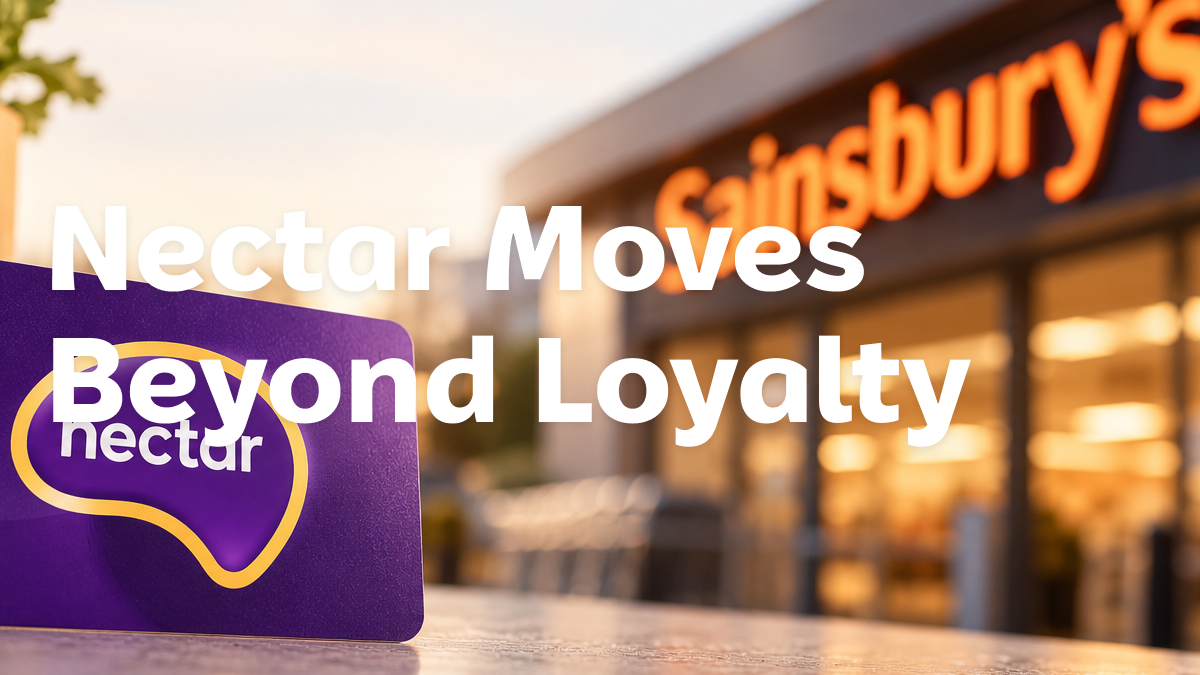
🇬🇧 Sainsbury’s turns Nectar into a financial distribution engine
Sainsbury’s Money has launched personal loans powered by NatWest Boxed, with Nectar members able to access a representative 6.3% APR rate subject to eligibility. An instant-access savings product is due to follow in October, while a Nectar-branded credit card is expected later this year.
The interesting part is not simply that a retailer is offering financial products. It is the distribution model. Sainsbury’s already has the customer relationship, behavioural data and loyalty infrastructure; NatWest provides the banking capability behind it.
That creates a very different proposition from a conventional bank trying to acquire the same customer independently. The financial product arrives inside an ecosystem where the customer already shops, earns and interacts.
Why this matters
Loyalty programmes are increasingly becoming distribution infrastructure. The next phase may be less about giving customers another way to earn points and more about using the existing relationship to sell adjacent products.
🇦🇺 Qantas puts loyalty directly inside the holiday booking journey
Qantas Loyalty has announced a technology partnership with Expedia Group that will power the Qantas Hotels & Holidays and Jetstar Holidays booking experience.
The new infrastructure is designed to put hotel and holiday booking, Qantas Points earning and redemption, and trip management into one connected environment. The platform will also integrate more deeply with the Qantas app and introduce machine-learning-powered recommendations.
This is a useful example of loyalty becoming part of the transaction rather than an additional layer applied after it. The customer doesn't need to leave the ecosystem to book accommodation and then separately think about how that booking relates to their loyalty status.
Why this matters
The value of a loyalty programme increasingly comes from where it sits in the customer journey. If loyalty is embedded at the moment of consideration and purchase, it has considerably more commercial leverage than a points balance customers check afterwards.
🇺🇸 Kroger turns everyday spend into a loyalty acquisition channel
Kroger has launched the Kroger Rewards World Elite Mastercard, connecting everyday card spending directly to its expanded rewards programme.
Customers can earn points through purchases and redeem them against groceries and fuel across Kroger’s network, while points earned through the card connect directly to existing loyalty accounts.
The strategic move is familiar, but the important detail is the convergence. Grocery loyalty is no longer restricted to what happens at the supermarket checkout. The customer can generate value for the programme through spending outside the core retail environment and then bring that value back into the Kroger ecosystem.
Why this matters
Co-branded cards are evolving from promotional loyalty mechanics into customer acquisition and spend-capture infrastructure. The retailer that owns the payment relationship can potentially capture far more of the customer's economic activity.
🌎 Mastercard is building the trust layer for agentic payments
Mastercard has expanded its Agent Pay programme with new trust and intelligence services designed for AI-initiated transactions.
The company says the framework will combine information around identity, intent, behavioural signals and fraud to help financial institutions and merchants understand transactions initiated by AI agents. The underlying issue is straightforward: if an agent is going to shop and pay on someone's behalf, merchants need to know who authorised the transaction and what that agent was actually allowed to do.
That makes this much more commercially interesting than another generic AI announcement. The infrastructure required for agentic commerce is beginning to look like a new payments stack, with identity, controls, authentication and fraud management built around non-human actors.
Why this matters
The next payment interface may not always be a person. The customer relationship still belongs to the person, but the transaction may increasingly be executed by software. Payments infrastructure now has to account for that distinction.
🇬🇧 Liberty Global takes AI customer service beyond the chatbot
Liberty Global has signed a three-year strategic partnership with Sierra to roll out AI-powered customer interactions across its operating companies.
The agreement covers customer interactions across chat, voice and text, with the stated aim of making journeys simpler while allowing human teams to focus on more complex cases.
The more significant point is the scale and positioning. This isn't being presented as a standalone chatbot experiment. Liberty Global is establishing a common framework that can be deployed across multiple businesses and customer channels.
Why this matters
The enterprise CX battleground is moving from “Can AI answer customers?” to “Can AI operate inside the customer journey?” The winners will need integration across channels, systems and workflows — not just a clever conversational interface.
🇺🇸 Salesforce buys deeper access to customer understanding
Salesforce has agreed to acquire Listen Labs, an AI-powered customer research and human-simulation platform.
Listen Labs uses AI agents to design research studies, conduct qualitative research and synthesise customer feedback. Salesforce says the technology will complement Marketing Cloud, Service Cloud and its wider AI portfolio.
The strategic significance is the connection between understanding the customer and acting on that understanding. Traditional customer research often sits in a separate layer from CRM execution. Bringing research capability closer to the CRM stack potentially shortens the distance between insight and action.
Why this matters
CRM is gradually expanding from a database of customer interactions into a broader customer intelligence layer. The competitive advantage will increasingly come from connecting what customers say and do with what the business actually does next.
🇺🇸 Rutter’s is unifying retail, foodservice and fuel around one commerce platform
US convenience retailer Rutter’s has signed a new multi-year agreement with NCR Voyix to deploy its commerce platform across retail, foodservice and forecourt operations.
The deployment brings together POS, kitchen, connectivity, commercial fuel payments and managed services, with the aim of creating a more unified operating environment across the customer's journey.
Convenience retail is a particularly useful example because the customer doesn't think in terms of separate systems for fuel, food and retail. They simply expect the whole visit to work.
Why this matters
The customer sees one brand, even when the business operates several systems. Unified commerce is increasingly about removing that technical fragmentation from the customer experience rather than simply making checkout faster.
🇦🇺 Woolworths extends the infrastructure behind digital gifting
Pine Labs has extended its technology partnership with Woolworths Group for another five years, continuing to power its gift-card ecosystem through Qwikcilver.
The expanded relationship will introduce deeper API integrations and support new digital stored-value experiences across physical and digital channels.
Gift cards can look like a relatively simple loyalty-adjacent product, but underneath them sits a complex ecosystem involving issuance, transaction processing, balances, redemption and omnichannel fulfilment. Making that infrastructure more flexible gives retailers considerably more room to build new customer propositions around stored value.
Why this matters
The interesting shift is from gift cards as products to stored value as infrastructure. Once the underlying system is flexible enough, retailers can use it across gifting, rewards, promotions and digital commerce rather than treating each use case separately.
🇪🇸 Getnet and Nayax push payments deeper into unattended commerce
Getnet and Nayax have announced a strategic partnership covering integrated payments and commerce services across Latin America and Iberia.
The rollout begins in Chile before expanding into Spain, Portugal, Brazil, Mexico and Argentina, connecting Nayax's payment technology with Getnet's acquiring network for businesses including vending, EV charging and self-service kiosks.
These are environments where the payment experience is the customer experience. There may be no cashier, app or traditional service interaction to compensate for friction at the point of transaction.
Why this matters
As commerce becomes increasingly unattended, payment infrastructure becomes customer-experience infrastructure. Reliability, local payment methods and a frictionless transaction aren't back-office concerns in these environments; they are the proposition.
🇺🇸 Convenience retail is becoming a unified loyalty-and-payment ecosystem
Lula Commerce has added native loyalty integrations to its first-party ordering platform, connecting programmes including Paytronix, Velocity, Patron Points, PDI and PAR.
The move allows customers to earn and redeem existing loyalty rewards through direct online ordering in the same way they do in-store. That may sound like a straightforward integration, but it addresses one of the persistent weaknesses in omnichannel loyalty: customers often have different experiences depending on where the transaction happens.
Bringing the programme into the retailer's own digital ordering channel means the loyalty identity travels with the customer rather than stopping at the physical checkout.
Why this matters
The future of loyalty is increasingly channel-independent. Customers don't think in terms of “online loyalty” and “in-store loyalty”; they think in terms of their relationship with the brand. The infrastructure now has to catch up.
The signal underneath the signal
This week's developments point in the same direction from very different industries.
Loyalty is moving into banking. Banking is moving into retail. Payments are becoming embedded inside commerce platforms. CRM platforms are absorbing customer research. AI is beginning to operate inside customer-service infrastructure rather than simply generating responses.
The common denominator is ownership of the customer context.
The strategic question for brands is therefore becoming less about which loyalty feature to launch next and more about which parts of the customer relationship they actually control — and which parts they are handing to partners, platforms or payment providers.
That is where the next competitive advantage is likely to be built.
The conversation doesn't stop here.
Join the people bulding & debating this - in real time.

TLP is a collective-led platform for people working in customer loyalty, CX, CRM and marketing.